How to keep...
Temperate zone Rat Snakes (Elaphe)
Freek Gillissen
INTRODUCTION
There are both large and small Rat Snakes. The smallest species reach approximately 70 cm whereas the larger ones can be over two and a half meters long. Species of the genus Elaphe inhabit Europe, Asia, and North and Central America. All are oviparous, except for the Chinese species Elaphe rufodorsata which is ovoviviparous. Halfway through the seventies, Rat Snakes became increasingly popular pets. They are beautiful, relatively easy to keep and often easy to breed.
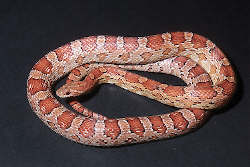
The first Rat Snakes that were bred in considerable numbers were the North American species. Elaphe guttata, the Corn Snake, is the ideal 'beginner's snake'. Based on personal experience, I will describe egg laying, incubation time and care of the offspring.
When you are about to obtain your first pet snake, it is strongly recommended to start with snakes that are bred in captivity. These animals are almost certainly free of diseases, and the person breeding them can be a valuable source of information in case problems arise. In this manner, the chances that your first snake will die, are considerably reduced.
A healthy snake is lively. If you pick it up, it will immediately attempt to escape after recovering from its initial shock. Corn Snakes are usually quiet and docile animals, but juveniles may bite on occasion.
SEXUAL DIMORPHISM
The base of the tail in female snakes tapers gradually from posterior to the vent down to the tail tip. In males the first few centimetres of the tail base, directly behind the vent, are more swollen because this is where its paired reproductive organs (the hemipenes) are stored. The tail tip in males is often longer and thinner than in females.
To verify the sex one can ask an experienced snake expert (or a veterinarian) to check your snake's gender by probing. This entails entering a very thin round-headed probe into the snake's vent towards the tail tip. In females there is hardly room to slide the probe in that direction, but in males the instrument can sometimes be inserted over two centimetres. This examination can be dangerous to the health of the animal so do not attempt it yourself.
TERRARIUM
For a pair of adult Corn Snakes a terrarium with a minimum size of 60x50x80 cm (lxwxh) is needed. Pay particular attention to the lid which needs to provide sufficient ventilation. The best types of terraria have two sliding glass doors in the front, but have an experienced snake keeper advise you on the construction of the container, as snakes are true escape artists. The decoration of the terrarium is best kept as simple as possible. An easily cleaned water basin is essential, these snakes drink often and large amounts. An old flower pot turned upside-down makes a great hiding place. This is especially important for gravid females and snakes that are in the process of shedding their skin. A number of branches for climbing increase the surface area inside your terrarium and are also useful for removing the old skin
For substrate I prefer beech shavings, but mulch is fine too. Some people prefer old newspaper, which is a good hygienic way to maintain your animals. A reflector light combined with a heat mat is an excellent way to heat the terrarium. Make sure that a spot with a temperature between 26 and 32ºC is available to the snakes so they can warm up. Prevent the snakes from lying on top of the light bulb or crawling between the light bulb and the socket because this may cause serious burns. If the temperature inside the terrarium is too high, the snakes will often lie in the water basin without having to shed their skin. Remember that in the summer months the ambient temperature can be sufficiently high so that the heating may be switched off and the snakes can be kept at room temperature.
BEHAVIOUR
In the warmer months of July and August (when the temperatures reaches around 25ºC), I often switch off the heating. Outside of this period, I heat the terrarium with a heat cable and a spot light. Starting in early October I stop feeding the snakes and let the temperature inside the terrarium drop to room temperature. The snakes will automatically stop eating and defecate to empty their bowels. This process will take between four and six weeks. The snakes are now ready for hibernation. The animals can either stay inside their terrarium or be transferred to hibernation containers. The temperature during hibernation should remain between 10-15ºC, but can be slightly lower occasionally as long as it remains warmer than 5ºC. I let my snakes hibernate in plastic containers which, save for a few ventilation holes, are completely closed. Inside the containers I put humid mulch or leaves. Watch out that the mulch is not too humid because otherwise the snakes will rot.
Around late February or early March I start increasing the temperature and the day length slowly. The animals awake from their hibernation, and if all is well, they will mate and start eating soon after. Make sure that, especially the females, eat as much as they can. Males hardly ever eat during the mating season. Between late May and late July the females will lay their eggs. I place the eggs in a plastic (freezer) box filled with humid mulch, vermiculite or sphagnum. Often females will eat less or even stop eating completely about two months before laying their eggs.
Corn Snakes are easy to breed. In the past I have incubated about 400 corn snake eggs resulting in about 350 juvenile Corn Snakes. Depending on its age, a corn snake will produce between 5-25 eggs. Soon after laying eggs, the females often eat large numbers of mice to recover from their big feat.
The eggs need a high relative humidity to hatch. The incubation temperature should be between 26-29ºC. After they are laid, the eggs should not be turned. Especially during the first two weeks the eggs will need a lot of water. Daily checks of the humidity of the substrate is highly recommended.
The young will hatch after about 60 to 70 days. A baby snake needs sufficient time to emerge from its egg and absorb the last remaining yolk. Once the juveniles are crawling around they can be removed from the incubator. I put the juveniles in separate containers with never more than two animals together. After ten days they shed their skin for the first time and right after they will usually start eating independently. Do not panic if a baby snake does not eat immediately. Never try to force feed them. Instead, put the snake in a small container with a baby mouse. Bear in mind that in nature Corn Snakes eat in the evening and at night. Generally, females start eating sooner and eat more. It is therefore recommended to feed the young individually. There is always a danger that two snakes will start eating the same prey from different sides. The larger snake will often continue eating and proceed to consume its smaller relative.
I have learned from experience that with every pair of snakes there is always one that will eat anything, even the mice that were meant for other snakes, and will thus grow much faster. It is therefore recommended to always watch the snakes eat, even the adults!
SPECIES
The subspecies of the corn snake, Elaphe guttata emory, is also easy to keep. Starting snake keepers should limit themselves to species that are being bred your geographical area by fellow enthusiasts. Other species that can be maintained in a similar fashion are the different subspecies of Elaphe obsoleta, in particular E. o. quadrivittata and E. o. rosaleni). Both Elaphe schrenckii and Elaphe bimaculata are easy to keep Asian snakes.
Some species, such as E. o. obsoleta, Elaphe taeniura friesi, and Elaphe carinata are not recommended for beginners. Because of their nervous disposition and adult length of two and a half meters they are not that easy to keep. The European Rat Snakes are not ideal for beginners either. Also, with the exception of Elaphe scalaris, these species are protected by law and can only be kept with a special permit.
FOOD
Rat Snakes' prey consists of mice and sub-adult rats. The prey size will depending on the size of the snake. Very young snakes, for example, will only eat recently born mice. After hibernation I add a multivitamin solution to the snake's drinking water or put a few drops on a prey animal. I adhere to the assumption that healthy prey animals contain sufficient minerals and vitamins to satisfy the snake's needs.
DISEASES
A well-fed, healthy snake has a beautiful, smooth skin. Loose pieces of skin often indicate a problem with the snake's health. Its colours need to be bright and the skin should be clear (except, of course, just before the snake sheds its skin when the eyes are milky and the skin is dull). A snake's back needs to be nicely rounded with a shallow furrow down the spine. It is important to watch the head carefully. If there are any swellings on the jaws (which often make the snake rub its head against a branch or the water basin) this indicates an infection which needs to be treated by a veterinarian.
Check carefully for parasites on the skin. Small black or red dots on the skin are blood lice, parasites that are hard to treat. It is not recommended to acquire such an animal. The best places to check whether a snake is infected with these parasites are the edges of the scales around the eyes and the skin folds underneath the head. Snakes infected with blood lice will stop eating. The lice parasitise the snake and eventually the snake will die from exhaustion and malnutrition. Confer with an experienced snake keeper or veterinarian if you need to treat an infection by chemical means.
It is tempting to keep several species of snakes in one terrarium. Do not do this, it is asking for problems. Only one species of Elaphe in each terrarium and preferably not too many individuals is ideal. Start with only one species and see how you enjoy keeping snakes before getting more. Do not buy a snake on a whim. Realise that snakes eat mice and verify that you will have access to sufficient food for your snakes. A good alternative is to breed your own mice, but this requires considerable time and space.
One concluding remark: start with a healthy, captive-bred animals from an experienced snake keeper!