How to keep...
Freshwater turtles
Jelle Hofstra
INTRODUCTION
Freshwater turtles possess a streamlined and usually shallowly domed carapace. Some exceptions are seen in the genus Rhinoclemmys and the box turtles Terrapene and Cuora. Freshwater turtles, as their common name implies, are inhabitants of a wide range of fresh water habitats. Malaclemys has even adapted to life in brackish water. Early in their evolution freshwater turtles divided into two separate lineages, the suborder Cryptodira and the side-necked turtles (suborder Pleurodira).
Cryptodires curve their neck in a vertical S-curve and pull it backward inside their shell. They are divided into approximately six families with about 120 species, of which the family Emydidae is the largest. One family containing only a single species is the family Platysternidae with the Chinese species Platysternon megacephalum. Another family is Kinosternidae with about 19 species. One of the largest freshwater turtles is the Alligator Snapping Turtle (Macroclemys temminckii) which, together with one other species, forms the family Chelydridae. This colossal animal may weigh close to 100 kg. I will not discuss the soft-shelled turtles of the family Trionychidae as they are difficult to keep in captivity.
Pleurodires hide their head with a horizontal S-curve underneath the front margin of their carapace. They are divided into two families: Chelids contain approximately forty species, while Pelomedusids have roughly twenty species.
BEWARE WHEN PURCHASING
Only purchase healthy animals, preferably captive bred ones (see NSV below). Healthy animals have clear eyes. Closed eyes indicate a cold or a vitamin A deficiency. The shell should be firm and undamaged. Apart from young animals, turtles with a soft shell often suffer from rachitis. Weak spots in the shell indicate shell rot. Healthy animals are alert and will immediately retract their head and limbs when touched. Turn the turtle on its back, a healthy animal will try to turn itself over. Additionally, a turtle should feel heavier than one might expect based on its size. Breathing with the mouth open and bubbles on the nose suggest a lung infliction, as does lopsided swimming.
SEXUAL DIMORPHISM
In very young animals it is almost impossible to distinguish the sexes. However, adults of, for example, the genus Cuora may surprise even experts sometimes. Generally, males can be distinguished from females by their concave plastron and the often more swollen tail base. Additionally, in males the vent is located more posterior on the tail than in females and is usually found near the rear margin of the carapace or beyond.
TERRARIUM
Freshwater turtles should be maintained in an aquarium with an illuminated lid. The top should be closed completely with glass panes, but leave open a narrow slit for ventilation. This construction will retain heat and prevent cold drafts from entering. The commercially available plastic containers with a plastic palm tree are better left in the store.
Like other reptiles, freshwater turtles regulate their body temperature through an external source of heat. In nature this is the sun. In captivity an ordinary light bulb attached in such a way that one basking spot will have a temperature of about 30-35°C will do just fine. For young turtles one can easily create such a basking spot by stacking some small rocks with the top ones just above the water surface. With mature turtles it is more sensible to construct a floating land surface. Fill this land area, which should be approximately 8 cm deep, with clean river sand. The animals can bask here and also lay their eggs.
The light bulb will allow the turtles to attain their optimal body temperature, which is essential for proper digestion of food. Additionally, the light bulb ensures that the air temperature is always a few degrees higher than the water temperature, and the water temperature will be slightly higher than the prevailing room temperature. Eight hours of light per day is sufficient. The cooler night temperature is needed for the animals to relax. Just to give you an idea of wattage and distances: with a 60W light bulb at a distance of 20 to 25 cm you will get good results. Avoid only using a heater in the water and not heating the air above. If the air temperature is lower than the water temperature, the animals will constantly inhale cold air and may contract a cold with a high risk of pneumonia.
The water level inside the aquarium should be slightly higher than the width of the shell of the largest turtle. An animal that accidentally ends up on its back will then be able to easily turn itself upright. If the water level is too low, young animals in particular are prone to drowning. The water basin may be filled with ordinary tap water but avoid large temperature differences when changing the water.
The size of the aquarium mostly depends on the size of the turtles. A plastic container 40x25x25 cm suffices for one or two small turtles measuring several centimetres. Such containers are easily managed and cleaned. Larger aquaria will need to be equipped with a filter and water pump. For substrate one can use a layer of river sand or coarse gravel.
In order to imitate nature as much as possible, it is recommended to vary the daylight length throughout the year. During the winter months, a day length of 8 hours is sufficient. Starting in early January, an extra fifteen minutes are added every week. With this schedule, the day length during the summer months will be between 14 and 16 hours. I also employ this routine for my tropical turtles. If possible, the animals should be given the opportunity to enjoy the real sun during the summer. An outdoor terrarium is ideal for this purpose (but watch for predators).
BEHAVIOUR
Do not house small and large animals in the same aquarium. Apart from the difficulties with the water level, bite wounds or worse are a possibility. Do not place very active animals with naturally quiet ones. The latter species will definitely be stressed and probably not have a chance to get to their food in time. In some species, such as Platysternon megacephalum, pairs can not be left in the same aquarium year round. Sexually active males may cause lethal injuries to the females.
If your turtles are properly cared for, chances are that they will eventually lay eggs. Females may become somewhat restless before oviposition. Some animals will make test nests in moderately humid (not soaking wet!) sand. The eggs can often be felt by carefully probing the animals groin area. This may be virtually impossible with Cuora species because of their hinged plastron. Additionally, a sudden increase in body weight may indicate that an animal is carrying eggs.
Once they are laid, mark the top of each egg with a pencil. After that they should never be turned over. The eggs are incubated in an incubator of the double boiler type. The incubating substrate may be humid sand, peat or the more popular vermiculite. The incubation temperature can be between 25 and 32°C, and the relative humidity around 90%. In most turtles their sex is determined by the incubation temperature. Generally, higher incubation temperatures result in a higher percentage of females, whereas lower temperatures result in more males. Somewhere in between is a temperature range in which both sexes will be present in a clutch.
House recently hatched animals in a small container with the correct water level. A light bulb above the water basin should provide a temperature of approximately 28°C. At such a high temperature, daily and varied food is essential.
SPECIES
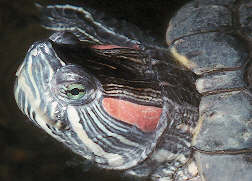
The generally very small Mud Turtles (Kinosternon) hardly require any special treatment as far as heating and lighting are concerned, and are therefore well-suited for beginners. Another easy to keep species is Trachemys scripta elegans although this turtle is already a little bit more demanding. The following species are relatively easy to keep and captive bred offspring are frequently available : Cuora amboinensis, C. flavomarginata, and Mauremys mutica.
Definitely not suited as pets are the soft-shell turtles of the genus Trionyx and a number of species of the terrestrial box turtles in the genera Terrapene and Cuora. Animals such as Cuora are often offered for sale in pet stores in very poor health and do not stand a chance of surviving with a beginner turtle enthusiast.
Limit yourself to pairs of one or a few species. Do not attempt to make a collection of very diverse individuals.
FOOD
Although some freshwater turtles are predominantly carnivorous, most species will readily accept vegetable matter. Make sure that you offer your turtles a varied diet. Vitamins and minerals are absolutely essential and should not be forgotten. Turtles also require a large amount of calcium. This is especially true for juveniles and gravid females. Add a few drops of a vitamin solution (Petaid, Turtle Vitamin or something comparable) to the water to provide them with vitamin A, D3 and calcium. You will need to estimate the dosage, which will depend on the amount of water in the basin, weight of the animals, etc.
Food may consist of boiled meat, ground beef (very good for mixing in a powdery vitamin supplement such as Gistocal or Carmix), white fish, worms (rich in calcium!), shrimp, heart, bait fish, etc. In the last few years many people have been using soaked dry cat food of various brands, but invariably without colorants. This provides complete nutrition, with vitamins and minerals already added. You can also experiment with well-cleaned fruits and vegetables. Turtles often have strange food preferences. A good source of calcium is ground up egg shells, which can simply be left in the water. The animals will eat these in large quantities so make sure that they are always available.
Do not use canned dry turtle food as it is too limited and may even lead to constipation in young animals.
DISEASES
Sick animals should be immediately separated from healthy ones. This in not just to prevent infection of other animals, but sick animals are often 'attacked' by the healthy ones .
Eye problems caused by a vitamin A deficiency are easily recognised because the animal will develop swollen eyelids that appear glassy. This can be cured by feeding the animal vitamin A rich food like liver for a week. Another possibility is to feed it ground beef with a considerable amount of Gistocal added to it. For extra support, a few drops of a vitamin A or AD3 solution can be administered to the animal on a daily basis. A third option is to have a veterinarian inject a dose of vitamin A.
Turtles with a cold can be recognised by bubbles on their nose and a raspy, discontinuous breathing. Because the turtle is short of breath, it will often open its mouth. These animals should be placed in a bucket with a thin layer of water. Hang a lightbulb Inside the bucket. The wattage of the bulb depends on the bucket's size. Cover most of the bucket with a towel. The water temperature should rise to approximately 30°C. Check this beforehand! It is critical to keep the water level at the same height because higher temperatures may occur with lowering of the water level or even the water dries up completely. This may prove lethal to the turtle, which has no way of escaping. Leave the light on day and night for about a week. An Elstein-light (which only produces heat but no light) is a good solution, especially at night. This increase in temperature usually works miracles. Make sure to feed the animal properly during this period, preferably a diet enriched with additional vitamins. If the animal's situation has not changed after a week, consult a veterinarian. Never experiment with antibiotics.
Shell rot is a problem that can be dealt with relatively easily. The cause of this ailment is not known, although 'hard' water has been mentioned. Both the plastron and the carapace may show weak spots. Upon removal of these spots, a scent reminiscent of a smelly muddy ditch is released. Carefully remove all soft tissue, loose scales and loose bone with a sharp knife or scalpel. Scrape the remaining bone clean and apply a generous amount of iodine tincture to the wound. After the tincture has dried, the animal can be placed in a separate container, either with or without water. If necessary, repeat the treatment.
Turtles that suffer from skin fungi, recognised by white, yellow or grey slimy spots, can be cured by bathing them in a salt (NaCl)-solution of 10 g/litre.
MAGAZINE AND INFORMATION
For the Dutch Magazine 'De Schildpad' obtain membership information from Guus Uytterschout (g.uytterschout@igr.nl).
For information on the Dutch Turtle Society (NSV) refer to http://www.igr.nl/users/nsv/